Dyslexia: a guide for parents, from evaluation to support plan
The school says your child reads more slowly than the others, or you have noticed it yourself: homework takes hours, spelling does not stick, tests go badly even when they studied. What now? This guide puts the steps in order, for families in the United States and families in the United Kingdom: how to get an evaluation, which support plan your child can have, how extra time in tests works and how to help at home without becoming a back-up teacher.
Rules differ from country to country, and in the US also from state to state. The guide explains the general framework; sources are at the end.
In short: the steps in order
| # | United States | United Kingdom (England) |
|---|---|---|
| 1 | Ask the school in writing for an evaluation | Talk to the class teacher and the SENCo |
| 2 | Evaluation by the school, free of charge | SEN support at school; a dyslexia assessment if needed |
| 3 | IEP (special education) or 504 plan (accommodations) | Support plan at school; EHC needs assessment only if needs are greater |
| 4 | Check that accommodations are used in every test | Ask the school about access arrangements before exams |
| 5 | Review at least once a year | Review each term (SEN support) or each year (EHCP) |
First of all: what dyslexia is
Dyslexia makes reading and spelling harder; it is the most common of the specific learning differences (in the UK, SpLDs; in US law, specific learning disability). Others are dysgraphia (handwriting), dyscalculia (numbers) and, often together with them, attention difficulties (ADHD). Many children have more than one.
Two things to know, and to tell your child:
- it has nothing to do with intelligence. Many very bright students are dyslexic;
- it does not go away, but with the right tools it weighs much less. The aim is not a “cure”, it is learning on equal terms.
In the United States
1. Ask for an evaluation, in writing
Under the Individuals with Disabilities Education Act (IDEA), public schools must find and evaluate children who may have a disability, at no cost to you. Write a short, dated letter or email to the principal or the special education coordinator: “I am requesting a full evaluation for special education services for my child, [name], because of difficulties with reading and spelling.” Keep a copy.
The school asks for your written consent, then has 60 days to complete the evaluation (some states set a different deadline). If you disagree with the result, you can ask for an Independent Educational Evaluation paid for by the school district.
A private diagnosis from a psychologist is useful, but the school must still run its own evaluation: bring the private report to the meeting.
2. IEP or 504 plan?
| IEP | 504 plan | |
|---|---|---|
| Law | IDEA | Section 504 of the Rehabilitation Act, and the ADA |
| For whom | Children who need specially designed instruction (for example, a reading program with a specialist) | Children who can follow normal lessons with accommodations |
| What it contains | Goals, services, minutes per week, accommodations | Accommodations (extra time, text-to-speech, notes provided…) |
| Review | At least once a year; re-evaluation every 3 years | Usually once a year |
Dyslexia falls under the IDEA category “specific learning disability”. If your child is found eligible, the school must hold the IEP meeting within 30 days. You are a member of the IEP team: you can bring notes, a private report and a person you trust.
3. Before signing, check
- The accommodations are specific: not “extra time when needed” but “50% extra time on all tests and quizzes, in a quiet room”.
- It says how tests are done: questions read aloud, typed answers, spelling not marked down in subjects other than English.
- It includes assistive technology your child already uses (text-to-speech, dictation, audio recordings of lessons).
- It applies to state tests too: accommodations for statewide tests must be written in the IEP or 504 plan.
- There is a name: who is responsible and when you will meet again.
4. State tests, SAT and ACT
Accommodations in the IEP or 504 plan carry over to state assessments. For the SAT and AP exams the request goes to the College Board (Services for Students with Disabilities), for the ACT to ACT’s accommodations service: usually the school’s coordinator submits it. Ask early, months before the test date.
In the United Kingdom
The system below is England’s. Scotland (Additional Support for Learning), Wales (Additional Learning Needs, with an Individual Development Plan) and Northern Ireland have their own rules, but the steps are similar.
1. Talk to the school and the SENCo
Every school has a SENCo (Special Educational Needs Co-ordinator). Ask for a meeting with the class teacher and the SENCo. Your child does not need a formal diagnosis to get help: under the SEND Code of Practice, the school puts in place SEN support with a cycle of assess, plan, do, review, usually reviewed with you each term.
2. A dyslexia assessment
A diagnostic assessment is carried out by a specialist teacher with an assessment practising certificate (APC) or by an educational psychologist. Some schools arrange one; often families pay privately. The report describes strengths and weaknesses and recommends adjustments: bring it to the SENCo.
3. EHC plan: only if needs are greater
Most dyslexic children are supported well at SEN support. If progress is still very poor, you can ask the local authority for an Education, Health and Care (EHC) needs assessment. The local authority must decide within 6 weeks whether to assess, and the whole process to a final EHC plan should take no more than 20 weeks. An EHC plan is legally binding and reviewed every year.
4. Exams: access arrangements
For GCSEs and A levels, adjustments are called access arrangements and follow the rules of the JCQ (Joint Council for Qualifications). The most common is 25% extra time; others are a reader or computer reader, a scribe or speech-to-text, a word processor, a separate room. The school applies, not the family, and it needs evidence: an assessment by a qualified assessor and a history of need (“normal way of working”). So the support must be used in class and in school tests well before the exams.
At home: helping without becoming the teacher
- Listen instead of read: audiobooks and text-to-speech let your child keep up with stories and subjects while reading improves.
- Short sessions: 20–25 minutes, then a break. Long evenings over homework wear everyone out.
- One thing at a time: split homework into small steps and tick them off.
- Praise effort, not only results; talk about famous dyslexic people with your child.
- Stay in touch with the school: a short monthly message is better than a crisis at the end of term.
Afterwards: college and university
- US: the IEP ends with high school. At college, the ADA and Section 504 still apply, but the student must contact the disability services office, with documentation, and ask for accommodations.
- UK: at university, students can apply for the Disabled Students’ Allowance (DSA) through Student Finance. After a needs assessment, it can pay for assistive software, equipment and study skills support. The university’s disability service arranges extra time in exams.
The most common mistakes
- Waiting. Every year without support is a year of effort and lost self-esteem.
- Asking only verbally (US): without a written, dated request, the deadlines do not start.
- Accepting vague accommodations: “when needed” usually means “never”.
- Using the tools only in exams (UK): without a history of need, access arrangements can be refused.
- Not involving your child: a student who is ashamed of the tools does not use them.
- Thinking the plan is forever: it must be reviewed, and changed when it does not work.
Sources
- U.S. Department of Education, Individuals with Disabilities Education Act (IDEA): 34 CFR §300.301 (evaluation, 60 days), §300.323 (IEP meeting within 30 days), §300.324 (annual review), §300.502 (independent evaluation). sites.ed.gov/idea
- U.S. Department of Education, Office for Civil Rights, Protecting Students with Disabilities (Section 504). ed.gov
- College Board, Services for Students with Disabilities. accommodations.collegeboard.org
- Department for Education, SEND Code of Practice: 0 to 25 years (2015): chapter 6 (SEN support), chapter 9 (EHC needs assessments and plans, 6 and 20 weeks). gov.uk
- JCQ, Adjustments for candidates with disabilities and learning difficulties: Access Arrangements and Reasonable Adjustments (updated every year). jcq.org.uk
- GOV.UK, Disabled Students’ Allowance (DSA). gov.uk
- This guide explains the general rules and does not replace the advice of the school, a specialist or a lawyer. Rules vary between US states and between the four UK nations.
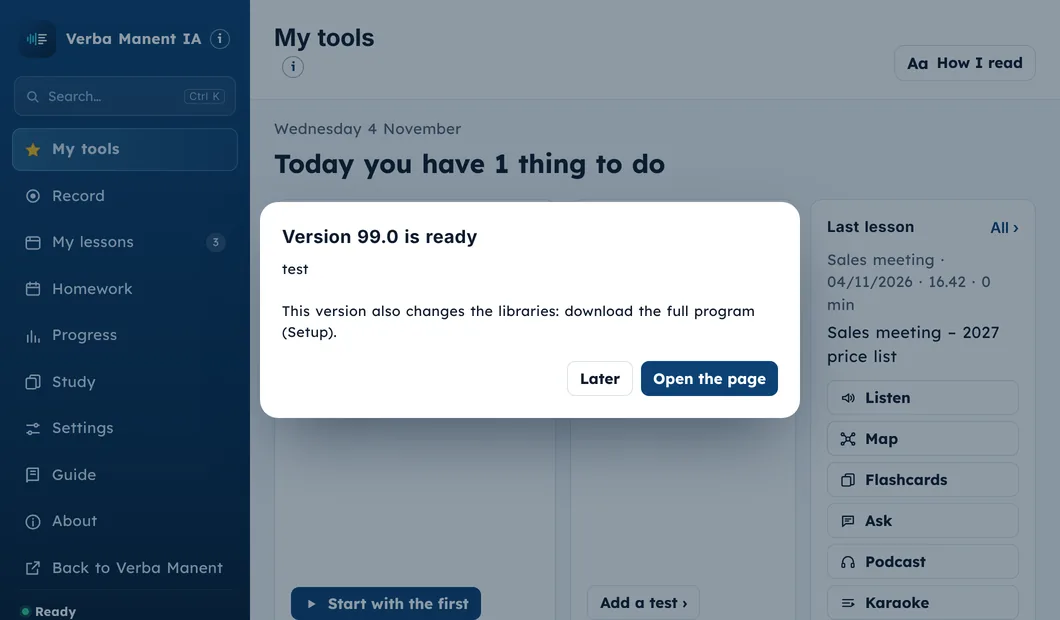
Verba Manent puts every assistive tool in one place
The tools in order: in class, after the lecture, for the test, for your teacher.
The lecturer's real voice with the words lighting up.
An A4 sheet with key words and formulas, with name and class.
The sheet for your school plan or university.