Assistive technology and accommodations for dyslexia: list, examples
Students with dyslexia and other specific learning differences (dysgraphia, dyscalculia) have the right to learn with the right tools. In the United States this comes from IDEA, Section 504 and the ADA; in the United Kingdom from the Equality Act 2010 and, in England, the SEND Code of Practice.
Three terms keep coming up: assistive technology, accommodations and modifications (in the UK people usually say reasonable adjustments). They are often confused, but they are different things. Here is what they are, a list with examples, how they are written into school plans and what you can ask for at college or university.
The difference in one line
| What it does | Example | |
|---|---|---|
| Assistive technology | A tool that replaces or eases a task the difficulty makes hard | Text-to-speech reads the text for you |
| Accommodation | Changes how the student learns or is tested, not what | 50% extra time, questions read aloud |
| Modification | Changes what the student is expected to learn or do | Fewer or simpler questions, a different assignment |
Neither is a shortcut: they level the playing field, so that what counts is what you know, not how fast you read or write. Most students with dyslexia need accommodations and assistive technology, not modifications.
Assistive technology: the list
| Tool | What it compensates for | Example |
|---|---|---|
| Text-to-speech | Reading: it turns a reading task into a listening task | Listening to the book or your notes instead of reading them |
| Audio recording | Taking notes while listening | Recording the lecture and listening again at home |
| Word processor with spell checker | Spelling and handwriting | Writing an essay on a computer |
| Speech-to-text dictation | Writing | Dictating answers instead of writing them |
| Calculator | Mental arithmetic | Using it in maths and physics problems |
| Reference sheets and formula sheets | Remembering formulas, rules, multiplication facts | The physics formula sheet during a test, if allowed |
| Concept maps and graphic organisers | Organising and recalling ideas | A map of the topic to plan an essay |
| Digital books and audiobooks | Reading long texts | The textbook as an accessible file, read by text-to-speech |
| Highly legible fonts | The visual effort of reading | Larger text, more line spacing, a soft background |
For students with dyslexia, the most useful tools are usually those that turn reading into listening and writing into speaking.
Accommodations: the list
The most common ones, in class and in tests:
- extended time in tests: in the US often 50%, in the UK often 25%; the exact amount depends on the evaluation;
- questions read aloud, by a person or by a computer reader;
- answers typed or dictated, or given orally;
- a separate, quiet room with fewer distractions;
- no reading aloud in front of the class unless the student wants to;
- notes or slides provided instead of copying from the board;
- tests announced in advance, not surprise quizzes;
- marking content, not spelling, outside the subjects where spelling is what is being tested.
- A different app for every tool
- Maps built by hand after every lecture
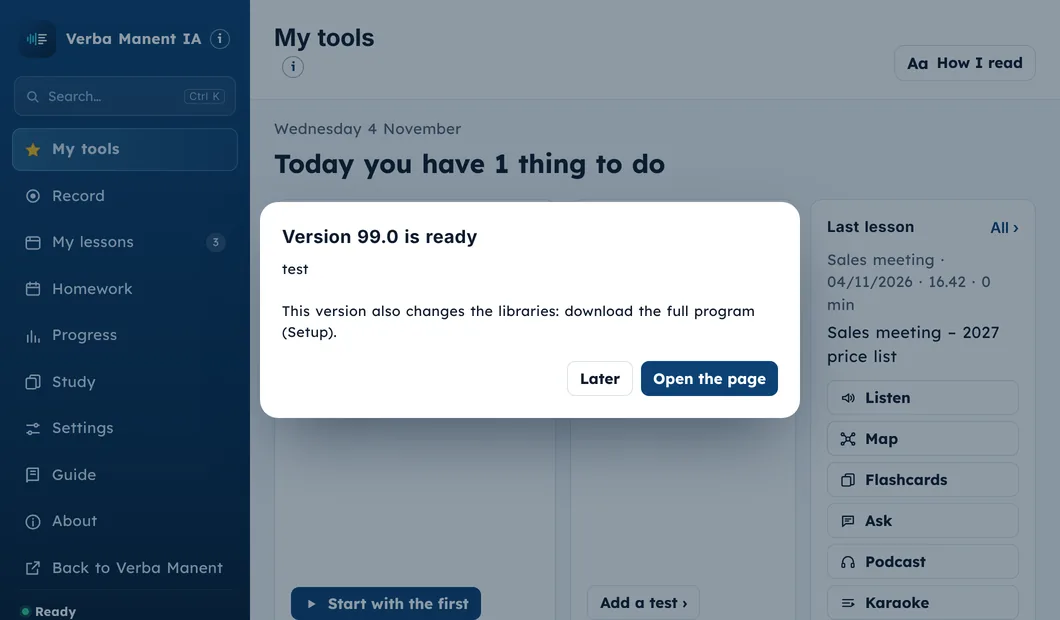
- Text-to-speech reads, but it isn't your lecturer's voice
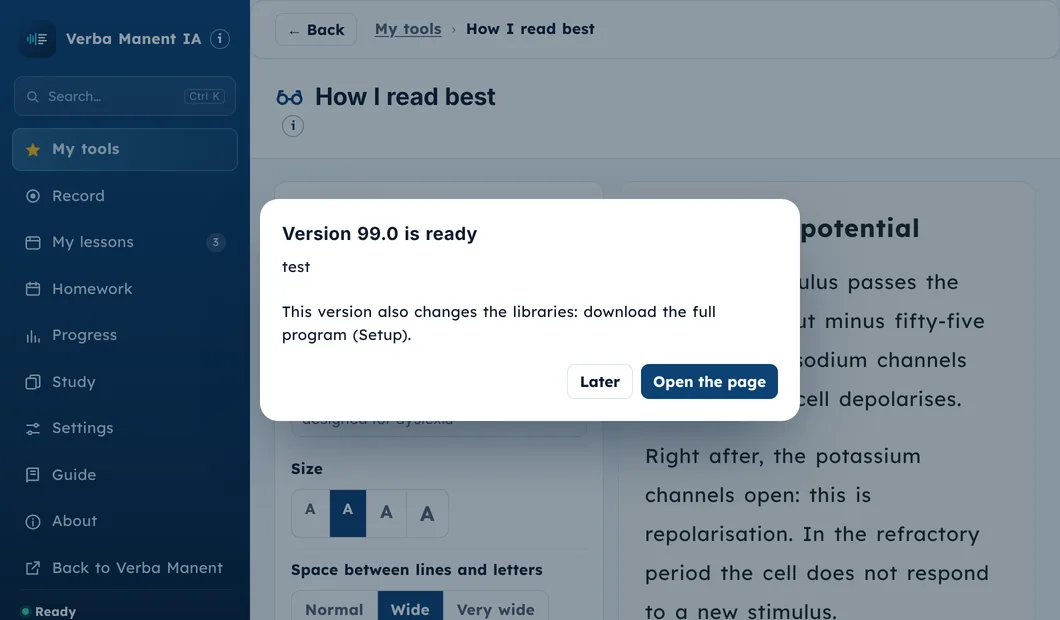
- Every tool in one place
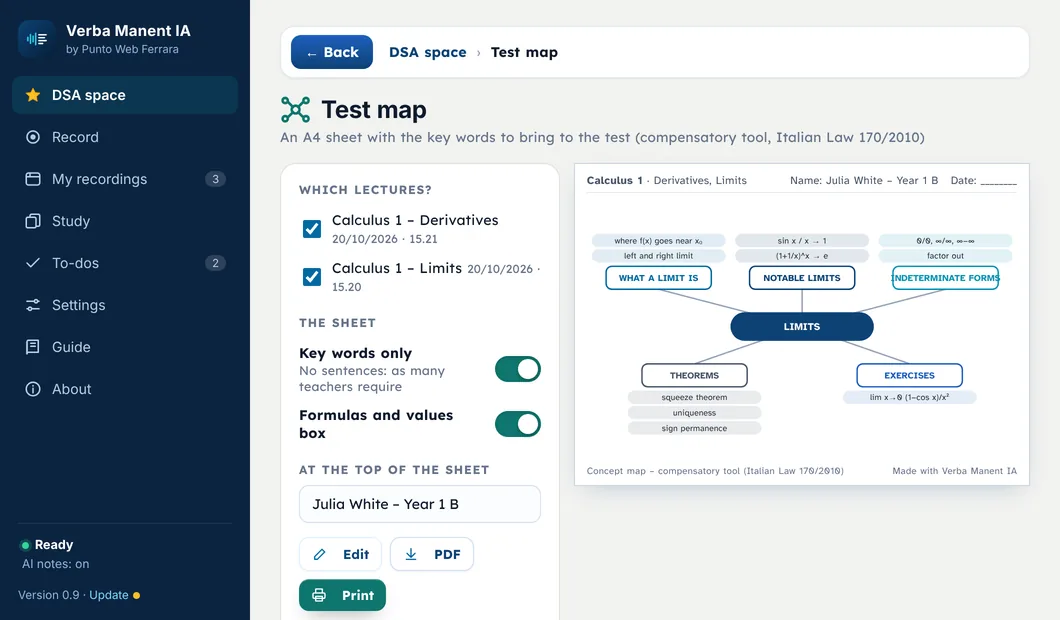
- A test map ready from your lectures
- Karaoke with the lecturer's real voice
At school: where they are written
| United States | United Kingdom (England) | |
|---|---|---|
| Plan | IEP (with specialised instruction) or 504 plan (accommodations) | SEN support plan; EHC plan for greater needs |
| Who writes it | The IEP team or 504 team, with the parents | The school and the SENCo, with the parents |
| In exams | Accommodations carry over to state tests; SAT and ACT need their own request | Access arrangements under JCQ rules, requested by the school |
A tip: bring the school a list of the tools you really use, subject by subject. A good plan is much easier to write starting from what already works. You can use our accommodations checklist.
At college and university
- US: the IEP does not carry over. Under the ADA and Section 504, contact your college’s disability services office with your documentation and ask for accommodations: extended time, a reduced-distraction room, lecture recording, accessible textbooks, note-taking support.
- UK: contact the university’s disability service, and apply for the Disabled Students’ Allowance through Student Finance: after a needs assessment it can pay for assistive software, equipment and study skills support.
Each college or university has its own procedure and deadlines: find out at the start of the course, not the week before the exam. All the details are in Dyslexia at college and university.
How to choose the right tools
There’s no list that suits everyone. A few practical criteria:
- Start from what costs you the most effort: reading, writing, remembering formulas, organising ideas.
- Try them calmly, before tests: a tool used for the first time on test day slows you down instead of helping. In England, using them in class is also what makes exam access arrangements possible.
- Agree on reference sheets with your teacher: many accept only key words, no sentences, and want to see them before the test.
- Keep the list up to date: what you need in middle school is not what you need at university.
The most common mistakes
- Thinking that using the tools is “cheating”: accommodations are a right.
- Asking for them too late, right before exams.
- Reference sheets that are too full, with whole sentences: they become a summary and the teacher won’t accept them.
- Using text-to-speech only to study and never to review: hearing a topic twice helps it stick.
- Not telling the teacher which tools you’ll use in the test.
Sources
- U.S. Department of Education, Individuals with Disabilities Education Act (IDEA): assistive technology devices and services (34 CFR §300.5–300.6). sites.ed.gov/idea
- U.S. Department of Education, Office for Civil Rights, Protecting Students with Disabilities (Section 504). ed.gov
- Department for Education, SEND Code of Practice: 0 to 25 years (2015). gov.uk
- JCQ, Access Arrangements and Reasonable Adjustments (updated every year). jcq.org.uk
- GOV.UK, Disabled Students’ Allowance (DSA). gov.uk
- This guide explains the general rules: for your own case, the evaluation, the school’s plan and your university’s policies apply.
Verba Manent puts every assistive tool in one place
The tools in order: in class, after the lecture, for the test, for your teacher.
The lecturer's real voice with the words lighting up.
An A4 sheet with key words and formulas, with name and class.
The sheet for your school plan or university.