Dyslexia at college and university: accommodations and extra time
At school there was a plan written by the teachers, and someone checked that it was followed. At college or university nobody comes looking for you: you have to ask for the support you are entitled to. The good news is that the law still protects you, and every college and university has a service whose job is exactly this.
This guide explains what a student with dyslexia or another specific learning difference can get, for students in the United States and students in the United Kingdom: who to contact, which documents you need, which accommodations are common in lectures and exams, and how to study with dyslexia during the semester. For the tools themselves, see the guide to assistive tools for dyslexia.
Rules and procedures differ between colleges and universities. The guide explains the general framework; sources are at the end.
In short: the steps in order
| # | United States | United Kingdom |
|---|---|---|
| 1 | Contact the disability services office of your college | Contact the university’s disability service (sometimes part of wellbeing or student support) |
| 2 | Send your documentation (evaluation, previous IEP or 504 plan) | Apply for the Disabled Students’ Allowance (DSA) with your diagnostic assessment report |
| 3 | Interactive process: a meeting to agree the accommodations | Needs assessment: a meeting to decide what the DSA will pay for |
| 4 | Accommodation letter for your instructors | Reasonable adjustments recorded by the university (often in a support plan) |
| 5 | Ask again every term or year if your college requires it | Check your adjustments are in place before each exam period |
The big change from school
- You start the process. Nothing happens until you contact the service: no one is told about your dyslexia unless you choose to disclose it.
- The aim is equal access, not a different course. Accommodations change how you learn and are tested, not what you must learn.
- It is confidential. Instructors usually receive a list of accommodations, not your diagnosis.
- It is not a weakness to ask. Disability services see many students with dyslexia every year, and instructors are used to accommodation letters.
In the United States
1. What the law says
The IEP ends with high school: the Individuals with Disabilities Education Act (IDEA) does not apply at college. What still applies is civil rights law: Section 504 of the Rehabilitation Act (for colleges that receive federal funding, which is almost all of them) and the Americans with Disabilities Act (ADA). Under these laws a college must not discriminate against you and must provide reasonable accommodations, but it does not have to design a special program for you or lower its academic standards.
2. Contact the disability services office
The name changes from college to college: Disability Services, Office of Accessibility, Disability Resource Center, Student Accessibility Services. Look it up on the college website as soon as you are admitted, not after your first bad test. Many offices have an online form for new students.
3. Documentation
You will be asked for documents that show your disability and how it affects learning. Requirements vary by college: some accept your previous IEP or 504 plan together with a meeting, others ask for a recent psycho-educational evaluation by a qualified professional. Colleges are not required to pay for a new evaluation. Read your college’s documentation guidelines before booking an expensive private assessment.
4. The interactive process
With your documents, you meet a disability specialist. Together you look at your needs and the demands of your courses and agree on the accommodations: this conversation is called the interactive process. Bring a list of what worked for you at school.
Typical accommodations for dyslexia:
| Accommodation | In practice |
|---|---|
| Extended time on tests and exams | Often time and a half (50% extra), sometimes more |
| Reduced-distraction room | Tests taken in a quieter room, often at the testing center |
| Note-taking support | Copies of slides, a peer note-taker, or note-taking software |
| Recording lectures | Permission to record, usually for personal study only |
| Text-to-speech and speech-to-text | Software to listen to readings and dictate answers |
| Alternative formats | Textbooks and readings as accessible digital files or audio |
| Spelling | A spellchecker, or spelling not marked in subjects where it is not the skill being tested |
The office then gives you an accommodation letter (or an online notice). It is usually up to you to share it with each instructor, often at the start of every term.
5. Graduate admission tests
Accommodations at college do not carry over automatically to graduate admission tests. The GRE (ETS), LSAT (LSAC) and MCAT (AAMC) each have their own request process, documentation rules and deadlines. Requests can take weeks to review, so apply well before the test date.
6. If something goes wrong
First talk to the disability services office; most colleges also have an internal grievance procedure or an ADA/504 coordinator. If the problem is not solved, you can file a complaint with the U.S. Department of Education’s Office for Civil Rights (OCR). There are time limits for complaints, so do not wait months.
In the United Kingdom
1. What the law says
Under the Equality Act 2010, universities must not discriminate against disabled students and must make reasonable adjustments so that you are not at a substantial disadvantage. Dyslexia is often covered by the Act’s definition of disability. Adjustments must not change the academic standard of your degree, only how you access it.
2. Disabled Students’ Allowance (DSA)
The DSA is extra funding for the costs of studying with a disability, including a specific learning difference such as dyslexia. You do not pay it back, and it does not depend on household income.
| Where you live | Apply through |
|---|---|
| England | Student Finance England |
| Scotland | Student Awards Agency Scotland (SAAS) |
| Wales | Student Finance Wales |
| Northern Ireland | Student Finance NI |
What usually happens:
- You apply, with evidence. For dyslexia this is usually a diagnostic assessment report by a specialist teacher or psychologist; check with your funding body whether an older report from school is accepted, as reports done after 16 are often expected.
- If you are eligible, you are invited to a needs assessment: a meeting with an assessor to discuss how you study and what would help.
- The assessor writes a report, and your funding body tells you what the DSA will pay for.
What the DSA can fund:
- assistive software: text-to-speech, mind-mapping, dictation, note-taking and recording tools;
- equipment, such as a computer or a digital recorder, when needed for your course;
- specialist study skills support: one-to-one sessions with a tutor trained in specific learning differences.
You can apply before your course starts: it takes time, so do it as soon as you have a place.
3. The university disability service
The DSA pays for tools and support; exam adjustments are arranged by the university. Register with its disability service (it may be called Disability and Dyslexia Support, Wellbeing or Student Support) and bring your report. Common adjustments:
| Adjustment | In practice |
|---|---|
| Extra time in exams | 25% extra is common |
| Rest breaks | Short supervised pauses during the exam |
| Separate or smaller room | Fewer people, fewer distractions |
| Computer in exams | Typing instead of handwriting, sometimes with a spellchecker |
| Lecture recordings | Access to recorded lectures, or permission to record |
| Coloured paper | Exam papers and handouts printed on the colour that suits you |
| Marking guidance | A sticker or note asking markers to focus on content, not spelling |
| Deadlines | Short extensions for coursework, if agreed |
The service usually writes a support plan and shares it with your department. Check before each exam period that your adjustments are on the exam timetable.
Talking to your instructors
An accommodation letter opens the door; a short conversation makes it work. Within the first weeks of each course:
- write a short email or go to office hours: introduce yourself, say you have an accommodation letter and ask how the instructor prefers to handle tests;
- ask about readings early: if you know the reading list in advance, you can get the texts in digital format and listen to them;
- tell them you will record lectures, if that is one of your accommodations: most instructors prefer to know;
- confirm exam arrangements a few weeks before the exam, not the day before.
You do not have to explain your diagnosis. Saying “I have dyslexia, and these are the arrangements that help me” is enough.
- A different app for every tool
- Maps built by hand after every lecture
- Text-to-speech reads, but it isn't your lecturer's voice
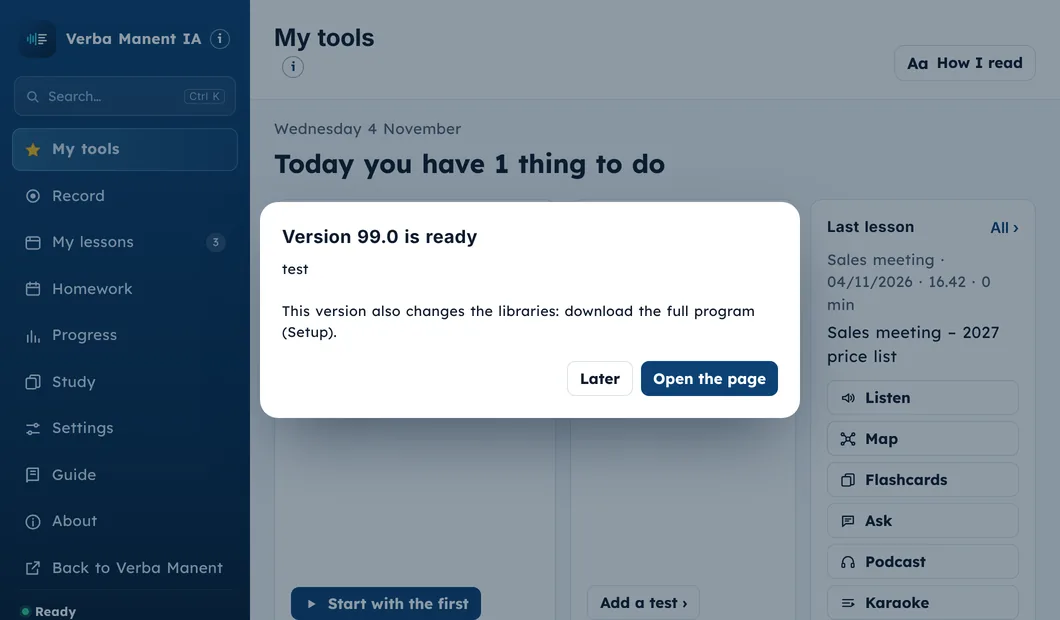
- Every tool in one place
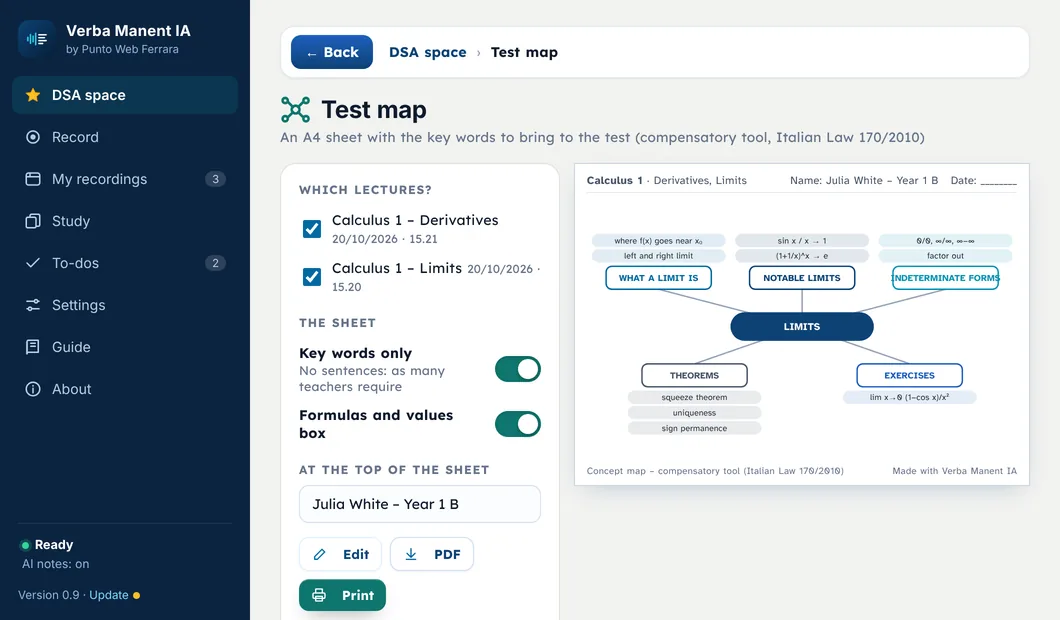
- A test map ready from your lectures
- Karaoke with the lecturer's real voice
Studying with dyslexia during the semester
Accommodations in exams help, but your method during the semester makes the difference:
- record your lectures and listen again, instead of rereading pages of notes taken in a hurry. Here is how to take notes in college;
- one map per lecture, made the same day: by the end of the course you already have your review material. Here is how to make concept maps;
- listen to readings with text-to-speech while you follow the text with your eyes;
- review at intervals, a little every day, instead of everything the week before. Flashcards help;
- practise with your exam timing, including the extra time you are allowed: knowing how long you have per question reduces anxiety.
The most common mistakes
- Waiting for the first bad grade before contacting disability services.
- Assuming the school plan carries over: in the US the IEP ends, in the UK the university needs its own evidence.
- Applying late for the DSA or for graduate test accommodations: assessments and reviews take weeks.
- Not giving the letter to instructors (US): accommodations that nobody knows about do not happen.
- Giving up the support for fear of being judged: it is your right, and it is confidential.
Sources
- U.S. Department of Education, Office for Civil Rights, Students with Disabilities Preparing for Postsecondary Education: Know Your Rights and Responsibilities. ed.gov
- U.S. Department of Justice, Americans with Disabilities Act. ada.gov
- ETS, Disability accommodations (GRE). ets.org
- LSAC, Accommodations for test takers with disabilities (LSAT). lsac.org
- AAMC, MCAT exam accommodations. aamc.org
- GOV.UK, Disabled Students’ Allowance (DSA). gov.uk
- GOV.UK, Equality Act 2010: guidance. gov.uk
- GOV.UK, Disability rights: education. gov.uk
- This guide explains the general rules and does not replace the advice of your college or university, a specialist or a lawyer. Procedures and documentation requirements vary between institutions, US states and the four UK nations.
Verba Manent puts every assistive tool in one place
The tools in order: in class, after the lecture, for the test, for your teacher.
The lecturer's real voice with the words lighting up.
An A4 sheet with key words and formulas, with name and class.
The sheet for your school plan or university.