How to study with flashcards (and still remember on exam day)
Flashcards are one of the simplest study tools there is: a card with a question on the front and the answer on the back. Yet they’re also among the most effective, as long as you use them the right way.
They’re the step that comes after your notes (if you need to start there, read how to take notes in college). This guide covers why they work, how to write them well and how to plan your review so that what you study today is still there on exam day.
Why flashcards work
Flashcards make use of two memory mechanisms that research has studied in depth.
1. Retrieving a memory strengthens it. When you flip the card and try to answer before looking, your brain works to recall the information. That effort is exactly what fixes it in place. Roediger and Karpicke (2006) showed that people who test themselves remember much more a week later than people who only reread.
2. Spaced review beats cramming. Seeing something several times, with the repetitions spread out, makes it last far longer than packing everything into one evening. Kornell (2009) tested this with flashcards specifically: studying a deck across several spaced sessions gave better results than studying it in a single session, with the same total time.
A major review of study techniques by Dunlosky and colleagues (2013) placed these two, self-testing and spaced practice, among the very few rated as having “high” utility. Rereading and highlighting, on the other hand, came near the bottom.
How to write a good flashcard
A badly written flashcard is just a summary chopped into pieces. These rules make the difference.
| Rule | Bad example | Good example |
|---|---|---|
| One thing per card | “Elements, effects and voidness of contracts” | “What are the elements of a valid contract?” |
| A precise question | “Mitochondria” | “What is the main job of the mitochondria?” |
| A short answer | Half a page of text | Two or three lines, in your own words |
| Questions that make you think | “What is inflation?” | “Why does high inflation hurt people with savings?” |
| A concrete example | Just the definition | Definition plus a real case |
More useful tips:
- write in your own words: rephrasing is half the studying;
- add a drawing or diagram when the topic is visual (anatomy, graphs, formulas);
- for long lists, make one card per item and one card for the full list;
- for fill-in-the-blank cards, hide a keyword in the sentence: “Mitochondria produce most of the cell’s ______” (answer: ATP).
The Leitner system: when to review each card
In the 1970s the German journalist Sebastian Leitner proposed a very simple way to put spaced review into practice, using boxes. It stops you wasting time on cards you already know and focuses you on the ones you get wrong.
| Box | When you review it | If you get it right | If you get it wrong |
|---|---|---|---|
| 1 | Every day | Moves to 2 | Stays in 1 |
| 2 | Every 2–3 days | Moves to 3 | Back to 1 |
| 3 | Every week | Moves to 4 | Back to 1 |
| 4 | Every 2 weeks | Moves to 5 | Back to 1 |
| 5 | Before the exam | Learned | Back to 1 |
The exact intervals can be adapted to the time left before the exam. What matters is the principle: hard cards come back often, easy ones less and less.
Paper or app?
Both work.
- Paper flashcards make you write by hand, which helps you remember. They’re perfect if you like to study away from screens.
- Apps (Anki is the most popular among university students) work out by themselves when to review each card, live on your phone and let you add images and formulas. They’re handy once your cards run into the hundreds.
The best choice is the one you’ll actually use every day.
- Hours spent writing cards by hand
- Risk of leaving topics out
- No idea what the exam will ask
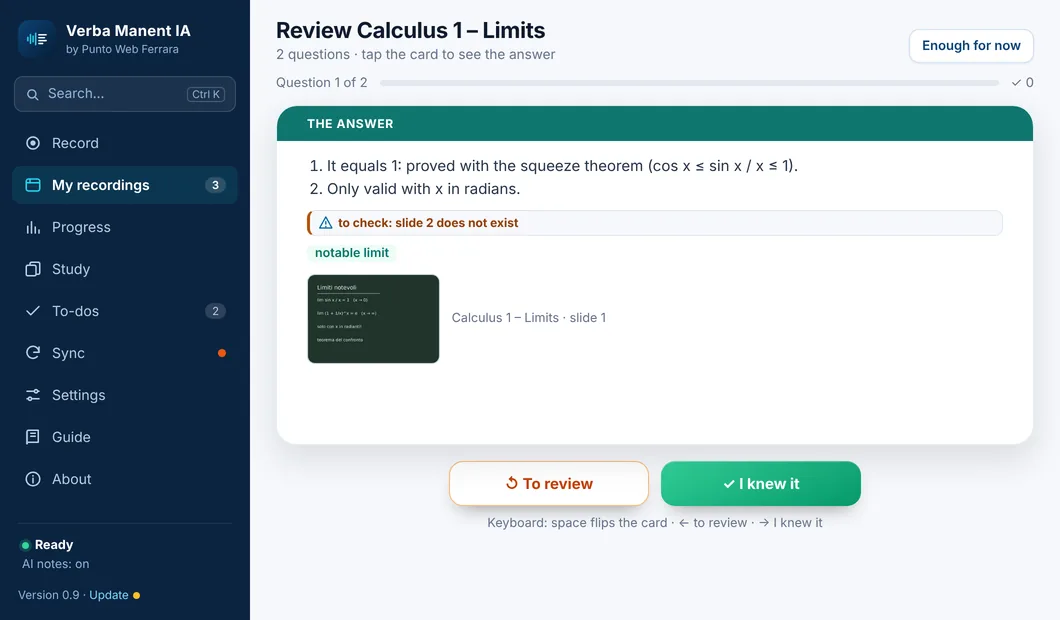
- Cards are ready when the lecture ends
- They cover the whole lecture, with the matching slide
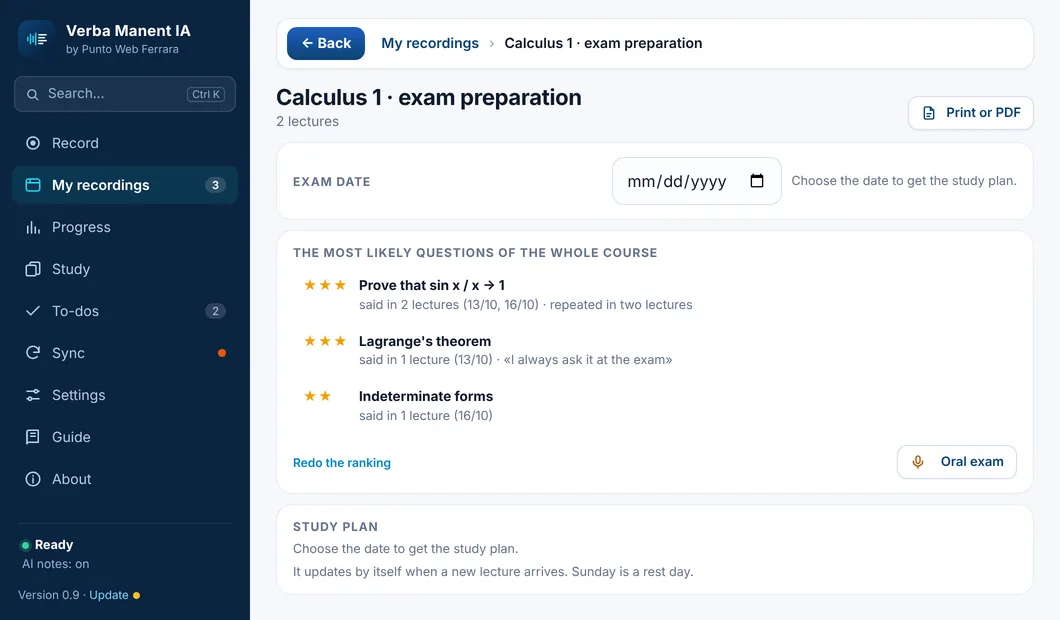
- The most likely questions marked with stars
The most common mistakes
- Flipping the card too soon: if you don’t really try to answer, the effect disappears.
- Cards that are too long and turn into textbook pages.
- Only reviewing the cards you know, because it feels good.
- Making all the cards the night before the exam: cramming is exactly what the research advises against.
- Using only flashcards even for topics that need reasoning: they help you memorise, but connections are built with diagrams and by explaining out loud.
Which subjects they help most
Flashcards are strongest wherever there’s a lot to memorise: legal definitions, medical terms, anatomy, dates, formulas, foreign-language vocabulary, statutes. They also work for reasoning-heavy subjects if the questions are of the “why” and “what happens if” kind.
Sources
- Roediger, H. L., Karpicke, J. D. (2006). Test-Enhanced Learning: Taking Memory Tests Improves Long-Term Retention. Psychological Science. doi:10.1111/j.1467-9280.2006.01693.x
- Kornell, N. (2009). Optimising learning using flashcards: Spacing is more effective than cramming. Applied Cognitive Psychology. doi:10.1002/acp.1537
- Dunlosky, J., Rawson, K. A., Marsh, E. J., Nathan, M. J., Willingham, D. T. (2013). Improving Students’ Learning With Effective Learning Techniques. Psychological Science in the Public Interest. doi:10.1177/1529100612453266
- Leitner, S. (1972). So lernt man lernen. Herder.
Verba Manent makes flashcards from every lecture
Questions and answers drawn from what the lecturer said.
Stars mark the questions that matter most for the exam.
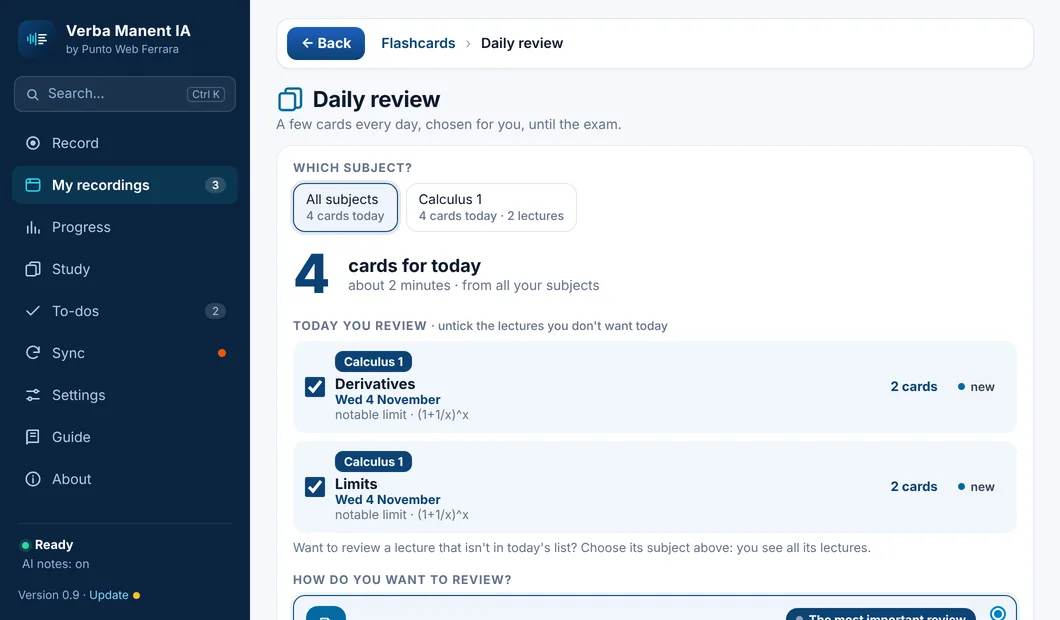
A few cards a day, the ones you miss first, until the exam.
One deck per subject, with the slide and the minute of the lecture.