How to take notes in college: the method that actually works
Two hours of lecture, a professor who talks fast, slides that change before you finish the sentence. At the end of the day you have three pages of notes and the feeling you missed exactly the part that mattered. It happens to almost everyone, especially in the first year.
Taking notes in college doesn’t mean writing down everything you hear. It means understanding during the lecture and locking it in afterwards. Here is a simple method in three stages: before, during and after the lecture.
Before the lecture: ten minutes that change everything
If the lecturer posts the slides or the syllabus, look at them first. You don’t need to study them: just know what’s coming and which terms are new.
- Read the slide titles: they give you the skeleton of the lecture.
- Mark the words you don’t know: in class you’ll know they matter.
- Set up the page already divided as explained below, in the Cornell method.
Arriving with a map lets you listen instead of chasing.
During the lecture: listen, don’t transcribe
The most common mistake is trying to write everything, word for word. It feels like the safe choice, but while your brain is copying it has no time to understand.
A widely cited study by Mueller and Oppenheimer (2014) found that students taking notes on laptops tended to transcribe the lecturer word for word, and did worse on comprehension questions than students who wrote by hand and summarised. Later studies found smaller differences between pen and keyboard, but they agree on one point: putting things in your own words helps you understand; copying doesn’t.
So during the lecture:
- write ideas, not sentences: keywords, arrows, examples;
- flag unclear points with a symbol (for example “?”) and keep going without stopping;
- capture what isn’t on the slides: examples, stories, “this will be on the exam”;
- use your own abbreviations, always the same ones.
If you miss a bit, leave a gap and carry on. You’ll fill it in later.
- You write in a rush and miss steps
- Head in the notebook instead of on the lecturer
- Notes need rewriting from scratch at home
- You listen and understand, writing only your doubts
- No missed steps: the whole lecture is there
- After class your notes are already in order
The Cornell method: the page split in three
The Cornell method was devised by Walter Pauk, a professor at Cornell University, and described in his book How to Study in College. It is still one of the most widely used methods in the world, and it works because it forces you to rework what you hear.
The page is split into three areas:
| Area | Where | What you write | When |
|---|---|---|---|
| Notes | Wide column on the right | Concepts, definitions, examples from the lecture | During the lecture |
| Cues: keywords and questions | Narrow column on the left | Keywords and the questions your notes answer | Right after |
| Summary | Strip at the bottom | The gist of the page in two or three sentences | Right after |
The trick is the left column: when you review, cover the notes, read only the questions and try to answer out loud. It’s a quiz you give yourself. You’ll find the whole method, with a full example, in the guide to the Cornell method.
After the lecture: the 24 hours that count
What you don’t review, you forget quickly: Hermann Ebbinghaus showed this back in the late 19th century with his “forgetting curve”. That’s why the best time to tidy up your notes is the same day, while the lecture is still fresh.
- Reread and complete: fill the gaps and resolve the “?” points with the textbook or by asking a classmate.
- Write the questions in the left column and the summary at the bottom.
- Turn the key ideas into flashcards: question on one side, answer on the other. Here’s how to write and review flashcards.
Reviewing: testing yourself beats rereading
Rereading notes gives you the feeling that you know the material, but it’s misleading. Roediger and Karpicke (2006) compared students who reread a text with students who tried to recall it without looking: a week later, those who had tested themselves remembered more.
So when you review:
- test yourself with the Cornell questions and with flashcards;
- spread your review over several days instead of cramming it all before the exam: a little and often beats a lot at once;
- explain the topic out loud, to a classmate or to yourself: if you can’t explain it simply, you haven’t understood it yet.
What about lecture recordings and transcripts?
Many students record lectures or share full transcripts within their course. They are useful for catching up on a missed lecture or checking a passage, but they don’t replace notes: reading a two-hour transcript is slow, and without reworking it you’re back to copying without understanding.
The best way to use them is as a source to complete your notes, not as a substitute.
One caution: before recording a lecture, check your university’s rules and ask the lecturer. Many institutions have a policy on it, and lecturers have rights over their lectures.
If you have dyslexia or another SpLD
Dyslexia, dysgraphia and the other specific learning difficulties make the very thing you do in a lecture harder: writing fast while you listen. That is why universities offer accommodations (in the UK, reasonable adjustments) such as recording the lecture, text-to-speech, concept maps and extra time in exams: ask your university’s disability services office.
A few practical tips:
- record the lecture (with the lecturer’s permission) and write down only key words and questions;
- turn your notes into a map: one page of connected concepts is easier to review than three pages of text;
- listen instead of rereading, with text-to-speech;
- choose the font and background that tire you least: many people with dyslexia read better with highly legible fonts, more line spacing and a soft background.
You’ll find every tool on the Scripta Manent page.
The most common mistakes
- Writing everything word for word.
- Stopping when you don’t understand something, and missing what follows.
- Not rereading your notes until exam season.
- Reviewing only by rereading, never testing yourself.
- Keeping notes from different courses mixed up, with no date or title.
Sources
- Mueller, P. A., Oppenheimer, D. M. (2014). The Pen Is Mightier Than the Keyboard: Advantages of Longhand Over Laptop Note Taking. Psychological Science. doi:10.1177/0956797614524581
- Morehead, K., Dunlosky, J., Rawson, K. A. (2019). How Much Mightier Is the Pen Than the Keyboard for Note-Taking? A Replication and Extension of Mueller and Oppenheimer (2014). Educational Psychology Review. doi:10.1007/s10648-019-09468-2
- Roediger, H. L., Karpicke, J. D. (2006). Test-Enhanced Learning: Taking Memory Tests Improves Long-Term Retention. Psychological Science. doi:10.1111/j.1467-9280.2006.01693.x
- Cornell University, Learning Strategies Center. The Cornell Note Taking System
Verba Manent takes the notes for you
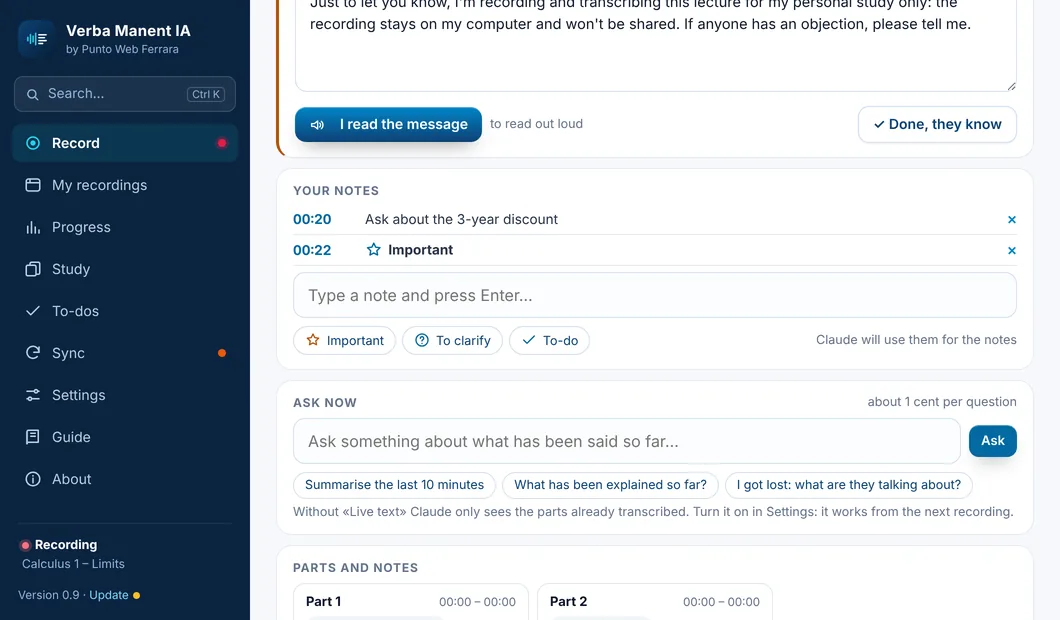
A couple of words or a star: the note gets the exact minute of the recording.
Attached to the right minute, and what's written ends up in your notes.
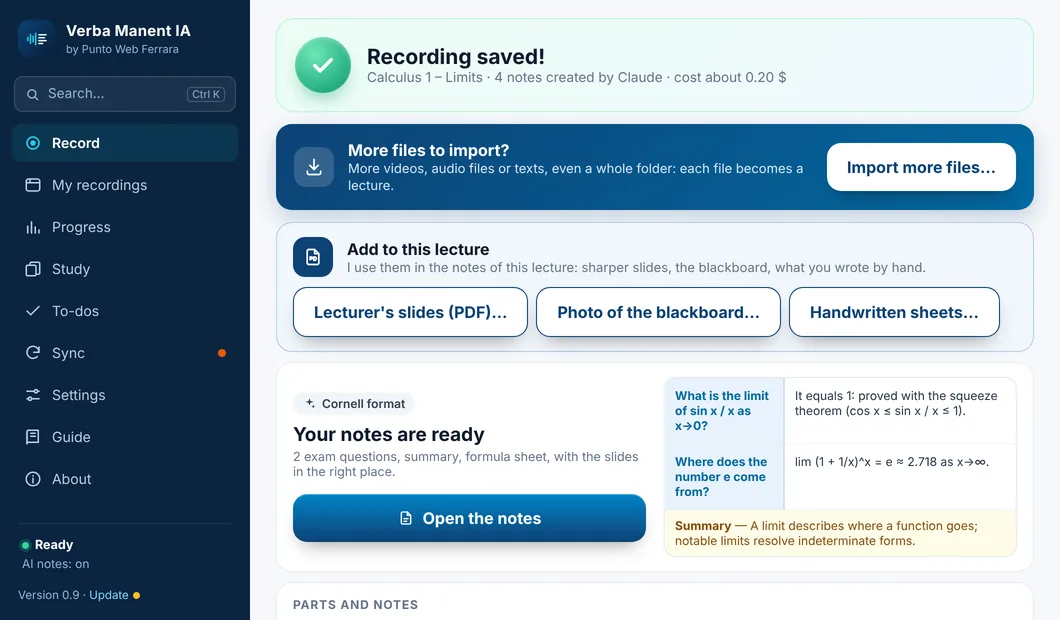
Cornell or exam-ready, with the lecturer's slides in the right place.
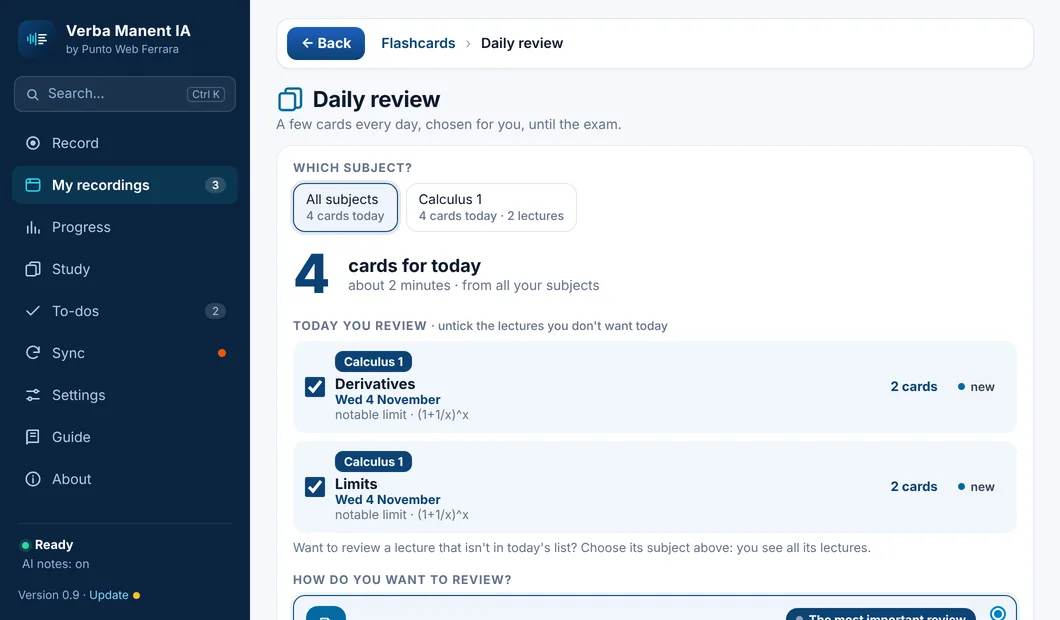
The lecture's questions ready for review.