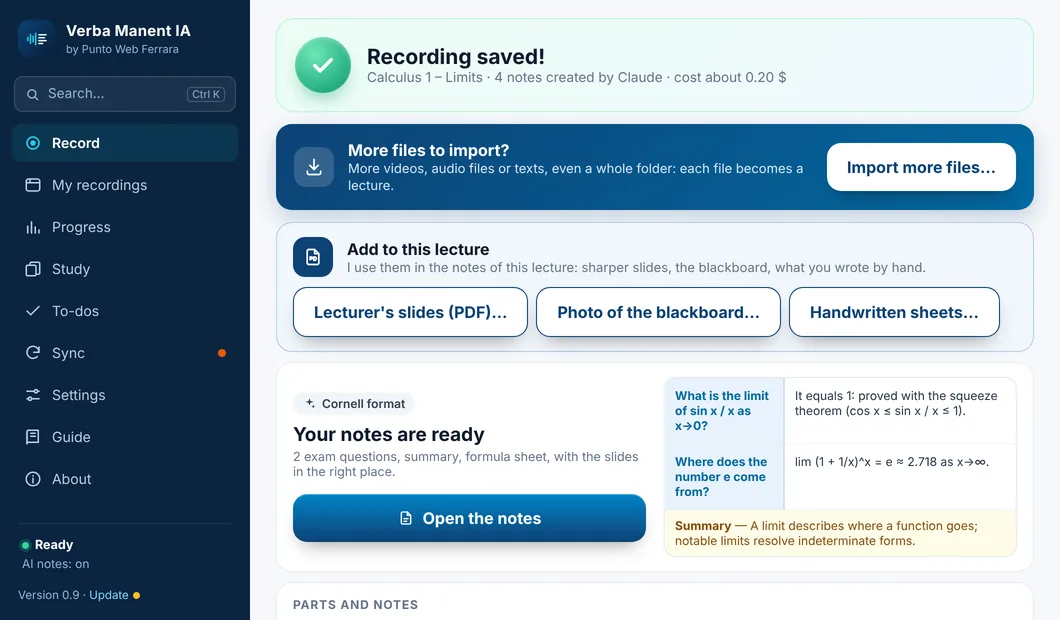
The Cornell note-taking method: how it works, with an example
The Cornell method is a way of taking notes that turns the page into a study tool. It isn’t just for writing during the lecture: it is built from the ground up for reviewing and testing yourself.
It was devised by Walter Pauk, a professor at Cornell University, who described it in his book How to Study in College. It is still one of the most widely used methods at universities around the world.
How to divide the page
The page is split into three areas, always the same way.
| Area | Where | Rough size (Letter or A4 sheet) | What goes in it |
|---|---|---|---|
| Notes | Wide column on the right | About two thirds of the width | What the lecturer explains: concepts, definitions, examples |
| Cues: keywords and questions | Narrow column on the left | About one third (around 2.5 inches) | Keywords and the questions your notes answer |
| Summary | Strip along the bottom | About 2 inches (5 cm) high | The gist of the page in two or three sentences |
At the top, above the three areas, always write subject, topic and date: in two months you’ll need it to find the right lecture.
The 5 Rs: how to use it
Pauk summed up the method in five steps, known as the “5 Rs”, each with its own moment.
| R | What you do | When |
|---|---|---|
| Record | Write the main ideas in the notes column, in your own words | During the lecture |
| Reduce | In the left column, write keywords and questions | Right after the lecture |
| Recite | Cover the notes, read the questions and answer out loud | Right after, then at every review |
| Reflect | Connect the topic to what you already know and write the summary at the bottom | The same day |
| Review | Every so often, go through the questions again, even for just a few minutes | In the following days and weeks |
The heart of the method is the third step: quizzing yourself with the left column. That is what makes it so effective, because trying to remember strengthens memory far more than rereading.
A complete example
Here is what a Cornell page might look like after a biology lecture.
What is photosynthesis?
Where does it happen?
What goes in and what comes out?
What are the two stages?
Why does it matter to us?
Process by which plants turn light energy into chemical energy (sugars).
In the chloroplasts, mostly in leaves. Pigment: chlorophyll (green).
In: CO₂ + water + light → out: glucose + O₂.
6 CO₂ + 6 H₂O → C₆H₁₂O₆ + 6 O₂
1) Light reactions: use light, make ATP and release O₂.
2) Calvin cycle (light-independent): uses ATP to fix CO₂ into sugars.
Produces the oxygen we breathe and is the base of almost every food chain.
To review: cover the right column and try to answer the questions on the left.
A few things to notice:
- the notes use short phrases, symbols and arrows, not full sentences;
- the questions on the left are real questions you can answer out loud;
- the summary doesn’t repeat the notes: it condenses them in a few lines, in new words.
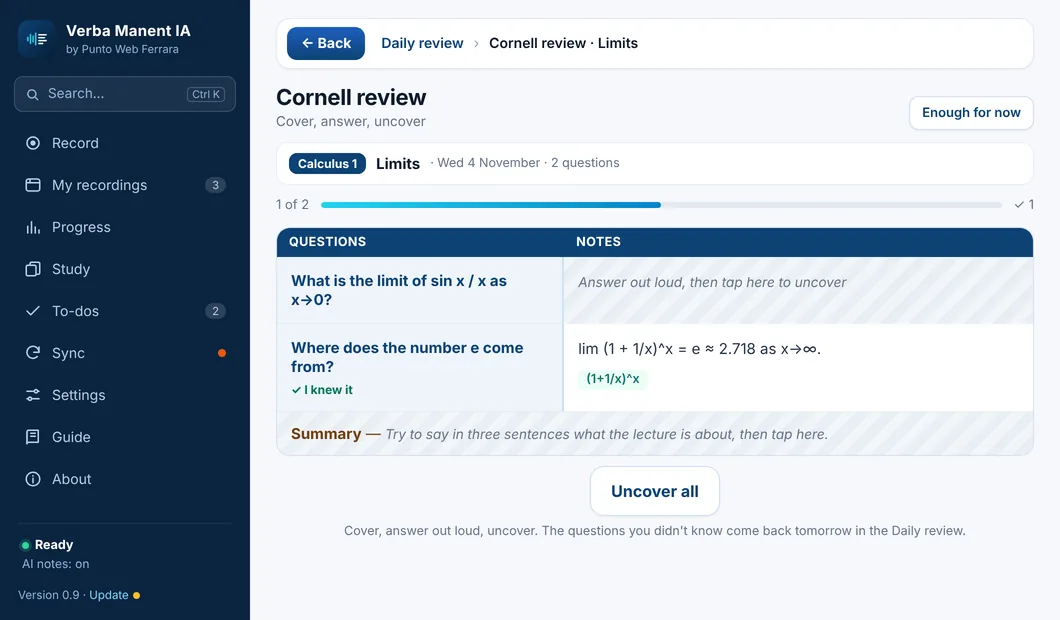
- Drawing the page layout every time
- Writing questions and summary by hand after class
- Pages that look different from one lecture to the next
- Cornell page already laid out
- Questions and summary written for you
- The same format for the whole course, as a PDF
On paper, laptop or tablet
The method works on any medium.
- On paper: draw a vertical line about a third of the way across and a horizontal one near the bottom. You can also buy notebooks pre-printed with the Cornell layout.
- On a laptop: in Word or Google Docs, a two-column table with a merged last row for the summary is all you need.
- On a tablet: handwriting apps let you use a Cornell template as the background of every page.
Pros and cons
| Pros | Cons |
|---|---|
| Every page is ready for self-testing | Takes a few minutes of work after the lecture |
| Forces you to rework ideas instead of copying | In very fast lectures the notes column fills up quickly |
| The summaries at the bottom become a digest of the whole course | Subjects with lots of formulas or graphs need more space |
Which subjects it suits best
Cornell shines in theory-heavy subjects full of concepts, definitions and connections: law, history, biology, economics, medicine, philosophy. In very technical subjects with lots of exercises, use it for the theory and keep the exercises on separate sheets.
For review, the questions in the left column turn easily into flashcards. And if you want a complete method for before, during and after the lecture, read the guide on how to take notes in college.
Sources
- Cornell University, Learning Strategies Center. The Cornell Note Taking System
- Pauk, W., Owens, R. J. Q. How to Study in College. Cengage Learning (several editions).
- Roediger, H. L., Karpicke, J. D. (2006). Test-Enhanced Learning: Taking Memory Tests Improves Long-Term Retention. Psychological Science. doi:10.1111/j.1467-9280.2006.01693.x
Verba Manent gives you Cornell notes ready-made
Keywords and questions, notes and summary, page after page.
The lecturer's slides placed at the right point of the lecture.
A ready PDF, with the font, spacing and background you prefer.
A second format built for review, alongside Cornell if you like.